
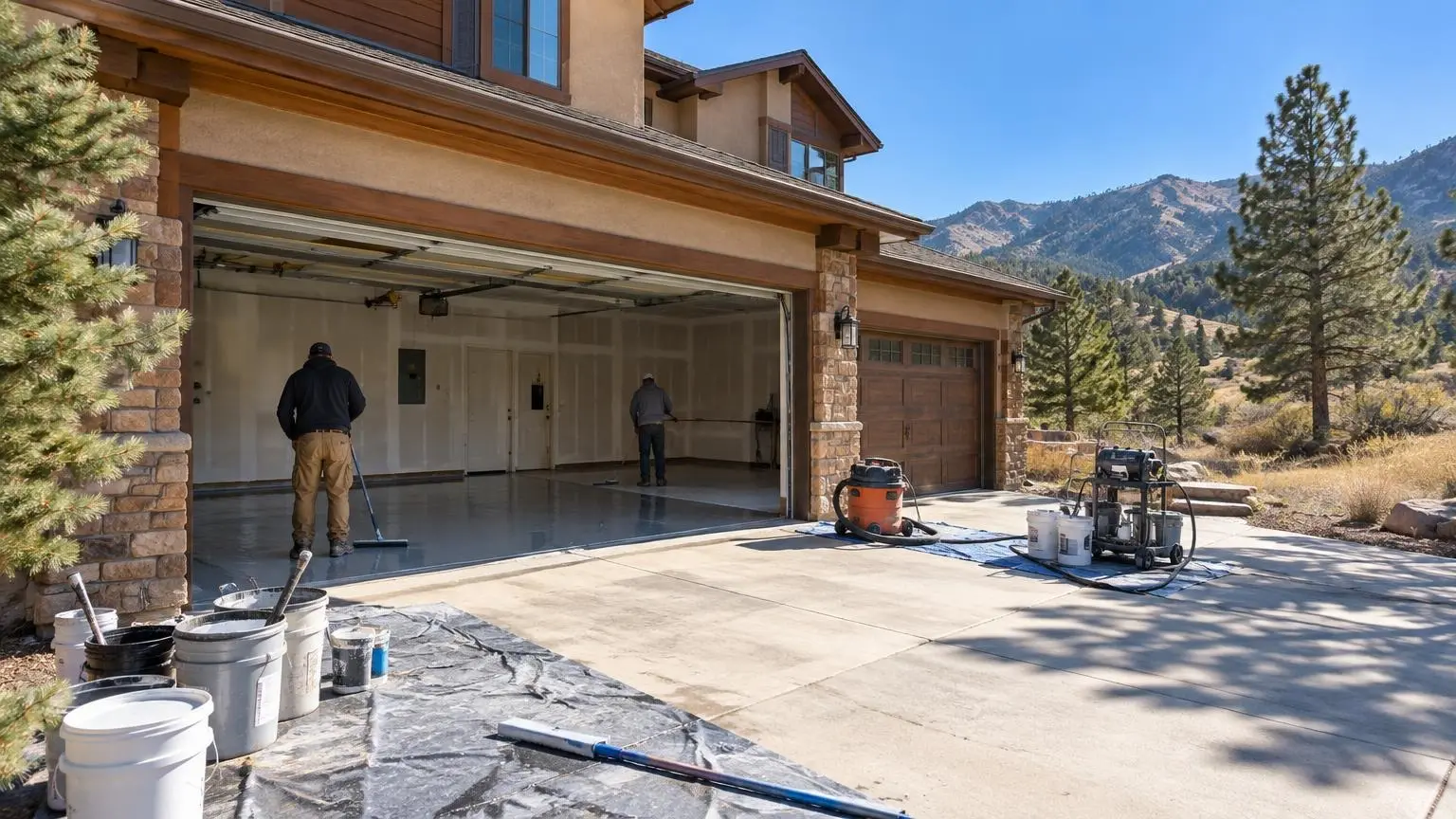
Flake systems for everyday garages
Garage Floor Epoxy in Boulder, CO
A full flake system that seals the slab against de-icer brine, oil and tire marks.
- Free on-site estimates
- Slab moisture-tested before we coat
- Written quote before work starts
What a Garage Floor Epoxy System Includes
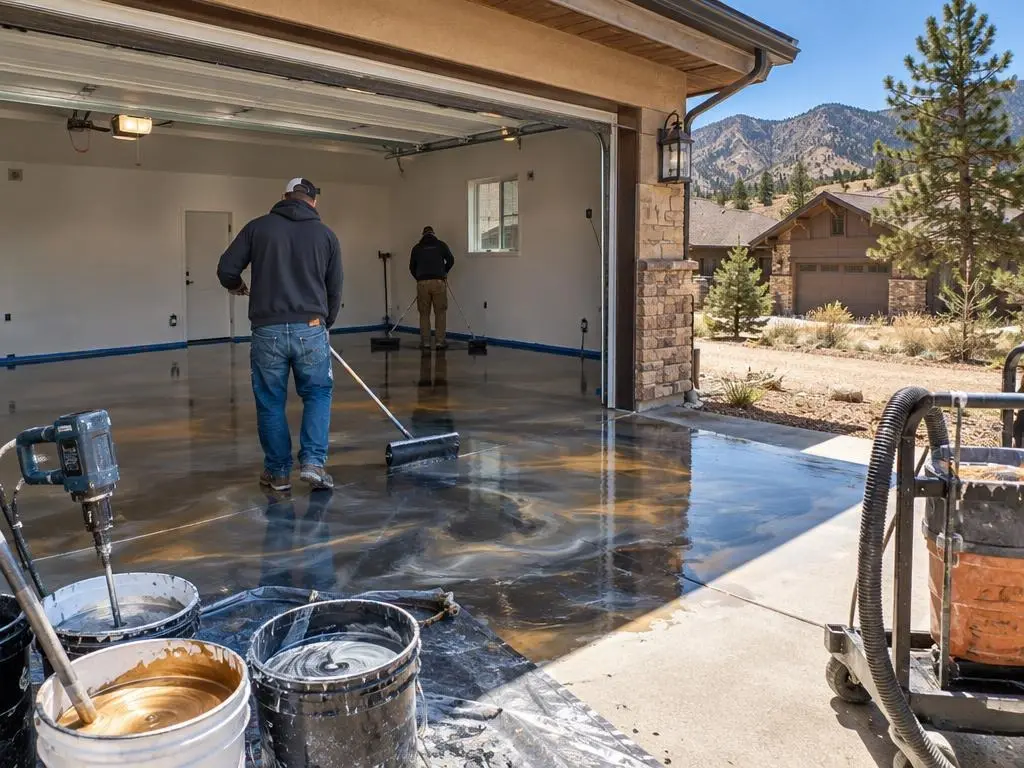
Garage floor epoxy is not a single coat of paint. A system that lasts in Boulder is built in layers: the bare slab is ground, cracks and pits are filled, a base coat goes down, colored vinyl flakes are broadcast into it until the surface is fully covered, the excess is scraped and vacuumed off, and a clear topcoat locks it all in.
That full broadcast is what makes the floor practical. The flakes hide the small flaws every slab has, add texture so the floor is not slick when snowmelt drips off a car, and give the topcoat something to grip. The result reads as a solid, speckled color that does not show dust and tire marks the way a plain gray coat does.
Signs your garage floor is ready for a coating
- Scaling or pitting near the door, where de-icer slush lands first
- Oil and antifreeze stains that will not scrub out
- Concrete dust that never seems to sweep up
- Cracks from settling or swelling soil that collect dirt
- An old paint or kit coating peeling at the tire lines
Why the topcoat matters on the Front Range
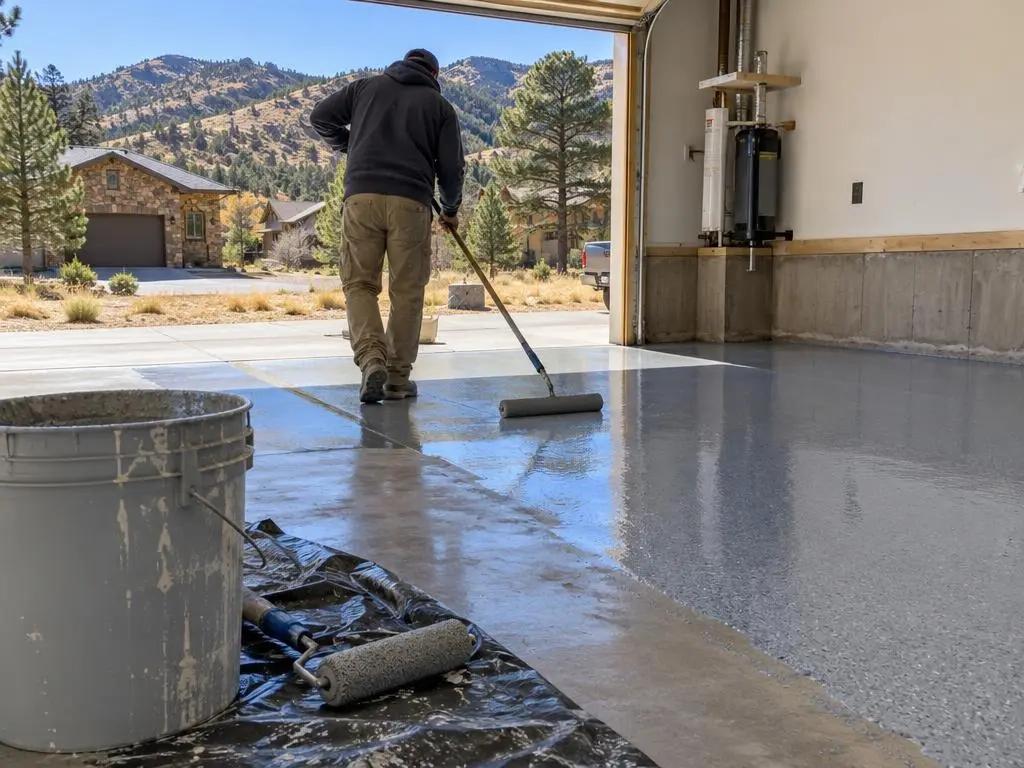
The base coat gives the floor its build; the topcoat takes the abuse. Standard epoxy topcoats can amber in sunlight, and at Boulder's elevation the sun through an open door is strong. That is why we recommend finishing garage systems with a polyaspartic topcoat, which stays clear, handles hot tires and resists the magnesium chloride brine tracked in all winter.
Picking a flake blend
Flake blends range from tight, small chips that read almost as a solid color to larger mixed chips with high contrast. Lighter blends brighten a garage and make dropped screws easier to find; darker blends hide tire marks and de-icer residue best. Bring a paint chip or a photo of your cabinets to the estimate and we will lay sample boards on your actual floor so you can see them in your garage's light.
Garages full of gear
A lot of Boulder garages hold more bikes, skis, boards and camping gear than cars. A coated floor makes that easier: wet ski boots and muddy tires drip onto a sealed surface instead of soaking into concrete, and grit sweeps right off. If you plan to mount racks or a work bench, tell us at the estimate so we can coat under anything that sits on the floor.
Why a do-it-yourself kit usually fails
Big-box kits are thin, often water-based, and rolled onto concrete that has only been etched or washed. On a Front Range garage floor, hot tires lift them in the tire lanes, and winter brine gets under the edges. A professional system differs in the parts you cannot see: mechanical grinding, a much thicker build and a topcoat made to take abuse.
What This Covers
These are the pieces of a typical garage floor job.
Diamond grinding
Opens the concrete surface and removes sealers, old paint and contamination so the base coat can bond.
Crack and pit repair
Cracks, scaling and control-joint damage are filled and ground flush before coating.
Full flake broadcast
Decorative vinyl flakes cover the base coat completely for texture, grip and a uniform look.
UV-stable topcoat
A clear polyaspartic topcoat seals the flakes and takes the wear from tires, tools and winter brine.
Typical Garage Floor Epoxy Costs
| Garage | Published national range |
|---|---|
| Professional epoxy, per sq ft | $3 to $12 |
| Two-car garage, about 360 sq ft | $1,100 to $4,300 |
| Two-car garage, about 500 sq ft | $1,500 to $6,000 |
| Three-car garage, about 750 sq ft | $2,250 to $9,000 |
Published national ranges from This Old House, Bob Vila and HomeAdvisor (2024 to 2026). Prices in the Boulder area can differ from national averages. Heavy crack repair, old-coating removal and moisture primers add cost. Your written estimate sets the price.
How It Works
1. Inspect and test
We measure, look at cracks, old coatings and signs of slab movement, and test for moisture.
2. Grind and repair
The floor is diamond-ground, then cracks and pits are filled and ground smooth.
3. Base coat and flakes
The base coat goes down and flakes are broadcast until the floor is fully covered.
4. Topcoat and cure
Excess flake is removed and the clear topcoat applied. You get a clear time for foot traffic and parking.
Garage Floor Epoxy Questions
Will magnesium chloride damage a coated garage floor?
A properly cured flake system with a polyaspartic topcoat resists de-icer brine. The weak points are chips, edges and the door threshold, so rinse brine off during winter and fix chips when you see them.
Can you coat over my old garage floor paint?
Not directly. Old paint and kit coatings are ground off first, because a new coating is only as strong as whatever is underneath it.
How soon can I park on it?
Foot traffic is usually fine within a day. Parking depends on the system and the temperature; we give you the exact window for your floor.
Is a flake floor slippery when snow melts off the car?
Full-broadcast flake floors have texture, and grip can be increased with an additive in the topcoat if you want more.
Do you coat the garage steps and the apron?
Interior steps and landings can be coated with the floor, usually with added grit for traction. The exterior driveway apron takes direct sun, standing water and plows, and is usually better left as concrete or treated with a penetrating sealer.
Garage Floor Epoxy Service Areas
- Epoxy Flooring in Boulder, CO
- Epoxy Flooring in Longmont, CO
- Epoxy Flooring in Niwot, CO
- Epoxy Flooring in Gunbarrel, CO
- Epoxy Flooring in Hygiene, CO
- Epoxy Flooring in Lyons, CO
- Epoxy Flooring in Louisville, CO
- Epoxy Flooring in Superior, CO
- Epoxy Flooring in Lafayette, CO
- Epoxy Flooring in Erie, CO
- Epoxy Flooring in Broomfield, CO
- Epoxy Flooring in Nederland, CO
- Epoxy Flooring in Jamestown, CO
- Epoxy Flooring in Eldorado Springs, CO
- Epoxy Flooring in Estes Park, CO
- Epoxy Flooring in Golden, CO
- Epoxy Flooring in Westminster, CO
- Epoxy Flooring in Arvada, CO
- Epoxy Flooring in Wheat Ridge, CO
- Epoxy Flooring in Federal Heights, CO
- Epoxy Flooring in Northglenn, CO
- Epoxy Flooring in Thornton, CO
- Epoxy Flooring in Brighton, CO
- Epoxy Flooring in Dacono, CO
- Epoxy Flooring in Frederick, CO
- Epoxy Flooring in Firestone, CO
- Epoxy Flooring in Mead, CO
- Epoxy Flooring in Berthoud, CO
- Epoxy Flooring in Loveland, CO
- Epoxy Flooring in Johnstown, CO
Get a Garage Floor Epoxy Estimate
Free on-site estimates for garage floors across the northern Front Range.